To try out the new LuxRender ( http://www.luxrender.net ) I have created a café chair with the following image as inspiration: Read More…
Posted by: Morten Nobel-Jørgensen | June 29, 2009
A chair rendered in LuxRender
Posted in Blender
Posted by: Morten Nobel-Jørgensen | June 1, 2009
The usual suspects
Being a noop in Blender, I’m constantly looking for shapes that challenges my blender skills. Currently I find most shapes either too easy or too hard to model. I finally found a challenge that seemed to fit: A set of chess pieces. I used my old chess game as ‘blueprint’ for my new model (I took this lousy photo): Read More…
Posted in Blender
Posted by: Morten Nobel-Jørgensen | May 21, 2009
Java 6 applets is coming to Leopard
Java 6 applets is coming to Leopard
The problem
 When Mac OS X version 10.5 “Leopard” was launched in October 2007, Java 6 finally reached the OS X platform (for 64-bit capable Intel-based Macs)– at that time Java 6 was almost a year old. But Apple only released a 64 bit version of Java 6 – while this seems like a logical step (Leopard is a 64 bit OS) allowing running Java for both servers, applications and Java WebStart, there was one drawback: Applet support.
All major browsers (Firefox and Safari) run in 32 bit mode on OS X, and since Java is started in the browser process, only the 32 bit Java 1.5 can be used.
This means that while you are able to develop a Java 6 Applet on OS X (since the Appletviewer has no problem running in 64 bit mode) you can’t run a webpage with a Java 6 applet. Absurd but true. Read More…
Posted by: Morten Nobel-Jørgensen | March 22, 2009
Improving image resizing quality in Java
This blog will describe some of the major changes and improvements in the Java Image Scaling Library, since my blog post Downscaling images in Java. A special thanks to Heinz Doerr who helped with many of the improvements. Read More…
Posted in Java | Tags: Image Scaling
Posted by: Morten Nobel-Jørgensen | March 7, 2009
The popularity of 3D Java game engines
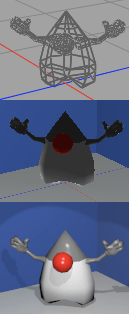 Getting started with 3D programming requires a bit of math (Vectors and Matrices) and a programming language with access to a 3D API. In Java 3D programming is typically done using the cross-platform OpenGL API, but there do also exist a bridge to Microsoft’s Direct3D.
Most often, programming your 3D applications at this level will get very complex, at least if you plan to create a more medium to large application such as a game. Instead of using the low level API, you would usually use a 3D scenegraph that hides much of the complexity and enabled you to be more productive. A 3D scenegraph is sometimes referred to as a 3D game engine, since they are often targeted games and has features such as sound, input and particle effects. Read More…
 Morten Nobel's Blog